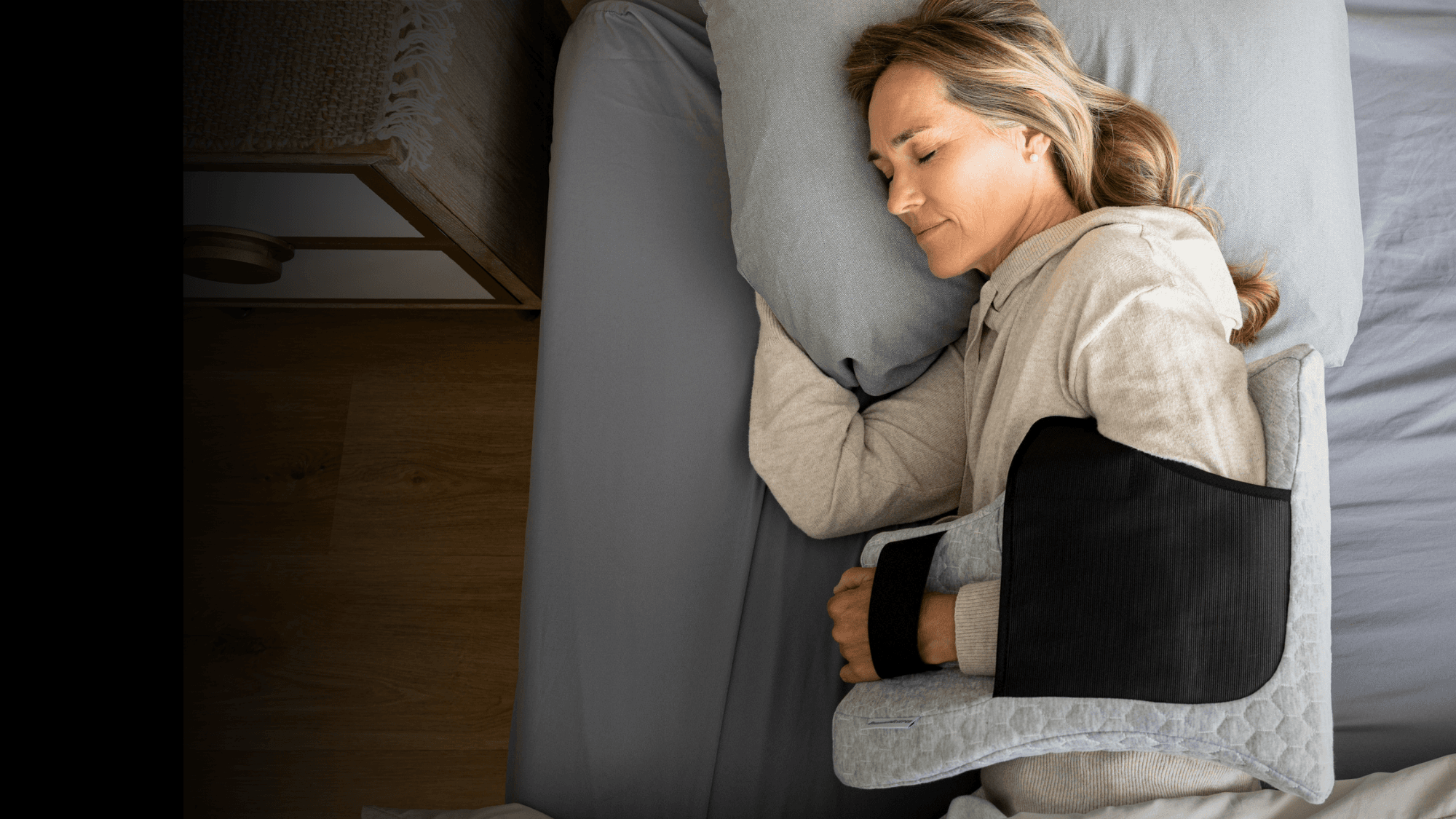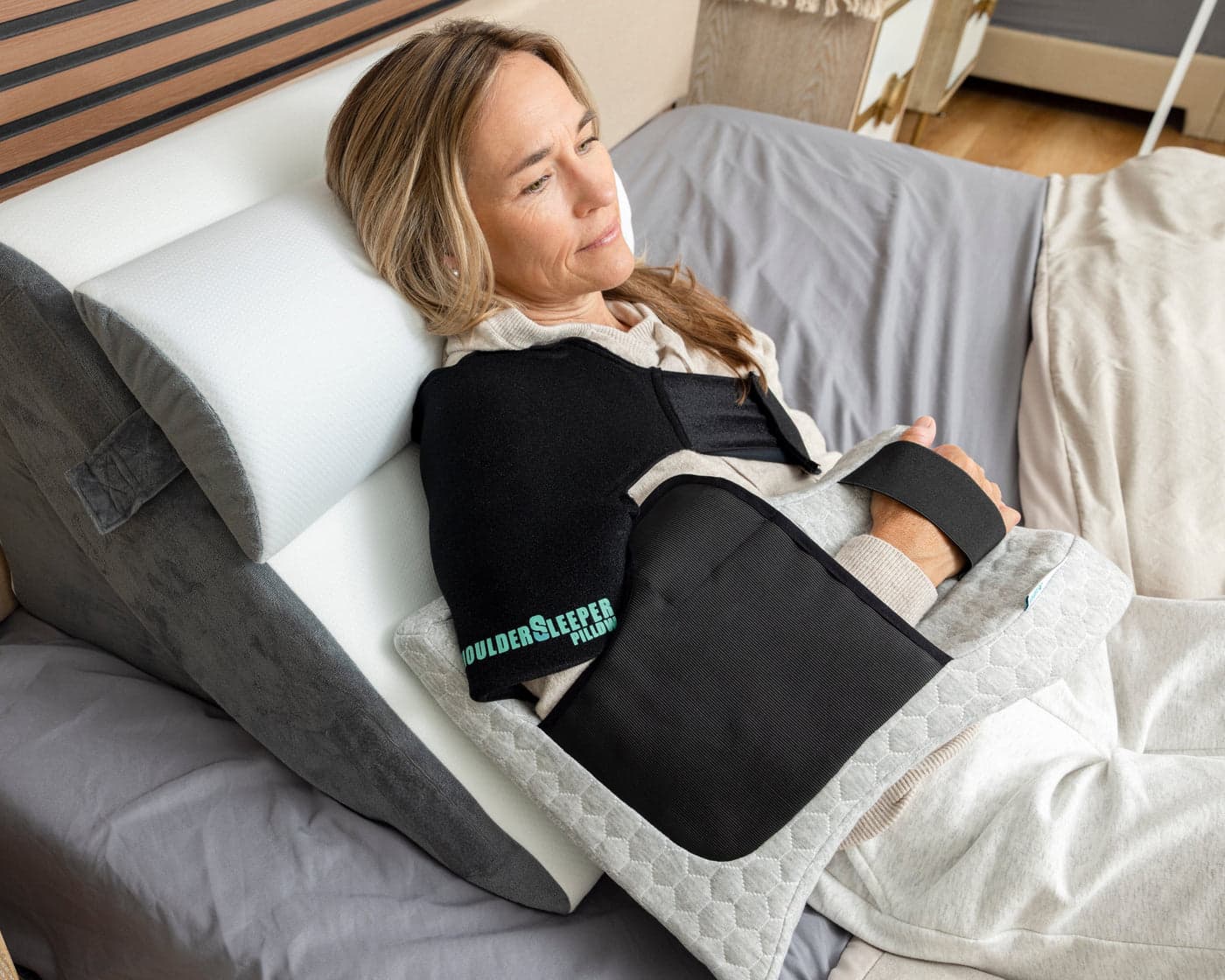
Shoulder Pain at Night: Why It's Worse When You Lie Down (and How to Sleep)
If your shoulder is fine all day and wakes you at 3am, you're not imagining it. Here's what's actually happening, what's likely causing it, and how to get a night's sleep while you sort out treatment.
Updated 13 August 2026 · 11 min read
There's a particular kind of tiredness that comes from shoulder pain. You get through the day fine — a twinge reaching for a high shelf, nothing dramatic — and then somewhere around two or three in the morning you're awake again, arm aching, trying to find a position that doesn't make it worse. After a few weeks of that, the tiredness starts to matter more than the shoulder.
It's an extremely common pattern, and it's not in your head. Here's what's going on.
Why shoulders hurt more at night
Several things stack up once you lie down.
The joint gets loaded differently
Standing up, your arm hangs from the shoulder and gravity gently opens the joint space. Lie on your side and the whole weight of your upper body compresses that same space against the mattress. Lie on your back and the arm can roll outwards or drop backwards, putting tension on structures that were already irritated. Neither position is one your shoulder chose.
Nothing is distracting you any more
Pain competes for attention. During the day it loses to work, conversation and movement. At night there's nothing else to attend to, so the same signal feels louder. This is a real, well-described phenomenon rather than a failure of willpower.
Inflammation has had all day to build
If you've been using the shoulder — and most people with shoulder pain keep using it — the tissues are more irritated by evening than they were at breakfast. Then you stop moving, and stiffness settles in on top.
Then the cycle starts
Poor sleep raises pain sensitivity, which makes the next night worse, which costs you more sleep. Plenty of people describe the sleep loss as more disabling than the shoulder itself — and breaking that loop is often what makes everything else improve.
What's likely causing it
Night pain is a symptom, not a diagnosis — but some conditions are far more associated with it than others.
- Rotator cuff tendinopathy or tears. The classic presentation: pain on the outside of the upper arm, worse reaching overhead, and notably worse lying on that side.
- Subacromial impingement. Pain when the arm is lifted into a certain arc, often with a similar night pattern.
- Bursitis. An inflamed bursa is exquisitely pressure-sensitive, which is why lying on it is intolerable.
- Frozen shoulder (adhesive capsulitis). Often the most severe night pain of the lot, particularly in its early painful phase, alongside progressive stiffness in all directions.
- Osteoarthritis. Deeper, more diffuse ache, often with stiffness that's worst first thing in the morning.
- Referred pain from the neck. Cervical spine problems can present as shoulder pain — a reason not to self-diagnose.
Sleeping positions that actually work
If you sleep on your side
The obvious advice — sleep on the other side — is right but incomplete, because the sore arm still ends up dangling across your body or collapsing towards the mattress. What works:
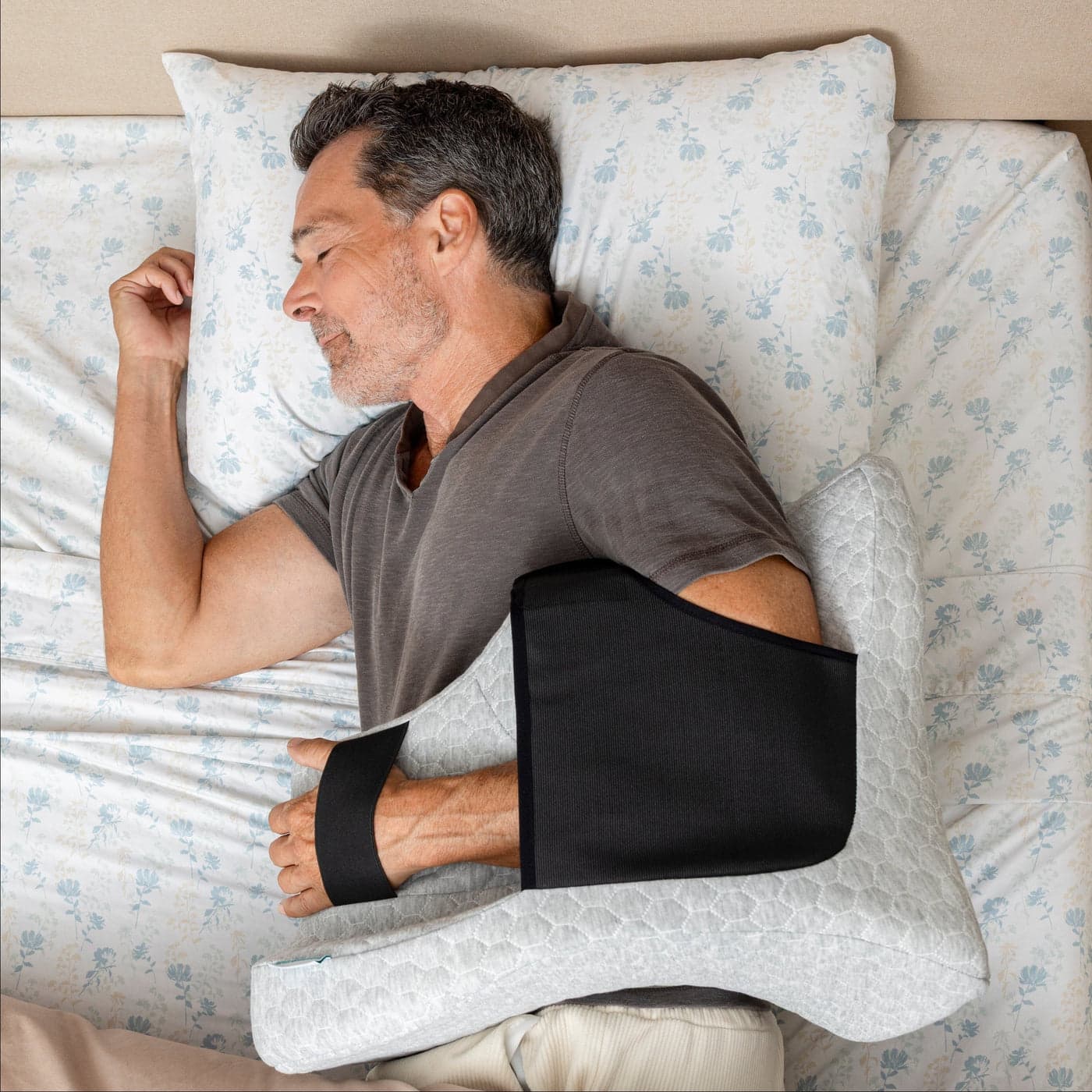
- Lie on the unaffected side, with a pillow hugged in front of you so the painful arm rests supported at roughly chest height rather than falling forward.
- Roll back slightly — a pillow behind your back stops you rotating fully onto your side and takes some load off the lower shoulder too.
- Keep the pillow height right for your neck. A too-low pillow tips your head down and drags on the shoulder girdle.
If you sleep on your back
- Support the elbow with a small cushion so the upper arm sits slightly forward of your body rather than rolling outwards.
- Try a slight incline — many people with inflammatory shoulder pain find a modest prop-up more comfortable than fully flat.
If you sleep on your front
This is the hardest position to make work with a painful shoulder — it usually forces the arm up and outwards into exactly the position that provokes impingement. Most people with night pain end up moving away from it, at least temporarily.
A bedtime routine for a sore shoulder
- 1Move it gently in the evening. Whatever range-of-motion exercises your physiotherapist has given you are usually better done a few hours before bed than not at all — but don't provoke it right before sleeping.
- 2Heat or ice, whichever helps you. Both are reasonable for chronic pain; ice tends to suit acutely inflamed shoulders, heat suits stiffness. Ten to fifteen minutes, not longer.
- 3Time any pain relief sensibly so it's working when you're trying to fall asleep — check with a pharmacist about what's suitable for you.
- 4Build the position before you're exhausted. Set the pillows up at nine, not at one in the morning.
- 5Protect the basics of sleep — a cool, dark room and a consistent bedtime matter more when pain is already interrupting you.
Getting it treated in the UK
Positioning helps you sleep; it doesn't treat the underlying problem. The usual route is: see your GP, or self-refer to physiotherapy where your area offers it. Most shoulder problems are managed without surgery — a structured exercise programme is the mainstay for cuff-related pain and impingement, sometimes with a corticosteroid injection to break a pain cycle. Imaging is generally reserved for cases that don't settle, or where surgery is being considered.
Tell whoever you see about the night pain specifically, and how many nights a week it wakes you. Clinicians take it seriously as a marker of severity, and it often shapes how quickly things move.
Frequently asked questions
Why does my shoulder hurt more at night than during the day?
Lying down compresses or stretches the joint in ways standing doesn't, inflammation has built up over the day, and there's nothing left to distract you from the pain signal. Add disrupted sleep raising your pain sensitivity, and the same shoulder that was manageable at lunchtime becomes unbearable at 3am.
What's the best sleeping position for shoulder pain?
For most people, on the unaffected side with a pillow hugged in front so the painful arm is supported rather than hanging, or on your back with the elbow supported and a slight incline. Front sleeping is the hardest to make comfortable, because it pushes the arm into the position that most often provokes shoulder pain.
Can a pillow really help shoulder pain at night?
Positioning genuinely changes how much load the joint takes overnight, so yes — support that stops the arm dragging on the shoulder helps a lot of people. What it doesn't do is treat the cause. Use it to get sleep back while you work through physiotherapy or whatever your clinician recommends.
How long should I put up with shoulder pain before seeing someone?
If it's waking you regularly for more than a couple of weeks, or limiting what you can do, it's worth getting assessed rather than waiting it out. Get seen sooner if it followed an injury, if you can't lift the arm, or if there's numbness, weakness, or redness and fever.
Is night pain a sign of a rotator cuff tear?
It's a well-recognised feature of rotator cuff problems, including tears — but it also occurs with bursitis, impingement, frozen shoulder and arthritis, which are managed differently. Night pain tells you the shoulder needs assessing; it doesn't tell you which problem you have.