Sleeping in a Sling: How Long, How to Cope, and What Actually Helps
The sling is the single most complained-about part of shoulder recovery — and the nights are why. Here's why surgeons insist on it, how long you'll realistically wear it, and how to make sleeping in one bearable.
Updated 4 August 2026 · 10 min read
Nobody warns you how much you will come to resent a piece of fabric. The sling is the constant of shoulder recovery: it's in the way when you dress, it's hot, the strap saws at your neck, and at night it turns a simple act — rolling over — into an impossibility. Most patients tolerate it during the day and find the nights genuinely miserable.
Understanding why it's there makes it easier to live with, and there are more practical fixes than most people are told about.
Why surgeons insist on the sling
After a repair, tendon has to heal back onto bone. That biological process takes weeks and is vulnerable early: the repair is at its weakest in the first phase, and the muscles that move the shoulder are exactly the ones being protected. The sling does two jobs — it holds the arm in a protected position, and it reminds you not to use it. The second job matters more than people think, because most damage happens through reflex movements: catching yourself, reaching for a falling cup, pushing yourself out of a chair.
At night the reminder function disappears — you're asleep. That's the whole argument for keeping it on in bed: not that the sling is comfortable, but that you cannot be trusted to keep your arm still when unconscious.
How long will you be in it?
This varies more than almost anything else in shoulder surgery — and that isn't sloppiness, it's a genuine gap in the evidence. NICE's guideline committee said so directly:
“The committee noted that the timing of shoulder mobilisation varies widely in practice, with some services advising use of a sling for 10 days and others advising it for 6 weeks. There was no evidence available on when the shoulder should be mobilised.”
So when your friend's surgeon said three weeks and yours said six, neither is wrong. The general shape across UK trusts:
| Procedure | Typical sling period | Notes |
|---|---|---|
| Rotator cuff repair | 3–6 weeks | Oxford: minimum 3 weeks, usually 4, up to 6 for a major repair. Small to large tears are often immobilised ~3 weeks, massive tears up to 6. |
| Anatomic shoulder replacement | 3–6 weeks | Often split — around 3 weeks day and night, then continued at night only for a further 3 weeks. |
| Reverse shoulder replacement | 3–6 weeks | Trusts vary widely: Oxford around 4 weeks, the Royal National Orthopaedic Hospital up to 6 with weaning. |
| Stabilisation / Bankart repair | 2–6 weeks | Liverpool describes two to three weeks "for comfort"; Latarjet procedures often run 3–6 weeks continuous with a body belt. |
| Hemiarthroplasty | 1–2 weeks | Considerably shorter than a full replacement. |
| Subacromial decompression | Days, not weeks | The Royal Orthopaedic Hospital advises 1–3 days and stresses discarding it after that "to prevent your shoulder becoming stiff". |
| Capsular release / MUA | Hours | Sling "only for comfort for the first few hours" — early movement is the point of the operation. |
The neck problem — and how to fix it
Most standard slings hang the entire weight of your arm from a strap that runs across the back of your neck. An arm is heavy. Over days, that produces a genuinely painful neck and upper trapezius, and it's a common reason people report their 'shoulder' hurting when the pain is actually somewhere else entirely.
The fixes, in order of effectiveness:
- 1Take the weight off the strap. Anything that supports the elbow from underneath — a cushion when seated, proper arm support when lying down — immediately reduces the pull.
- 2Pad the strap. A folded flannel or a purpose-made sleeve under the strap spreads the load. Cheap, and it works.
- 3Move the strap position slightly day to day so it isn't always sitting in the same groove.
- 4Check the fit. A sling adjusted too long lets the arm hang; too short and it hitches your shoulder up towards your ear. Your physiotherapist can set it properly — many patients have simply never had it adjusted since the ward.
Making sling nights bearable
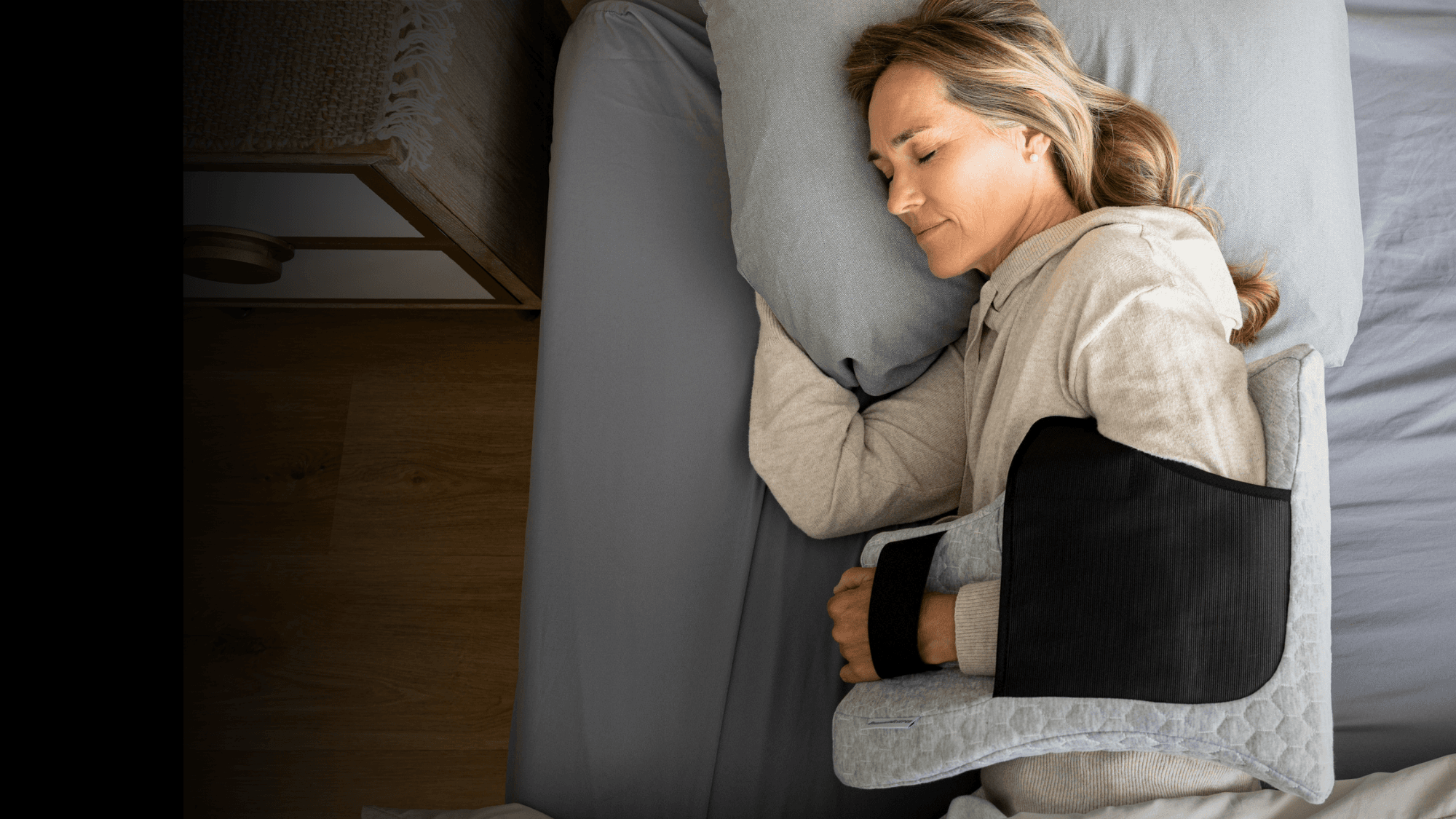
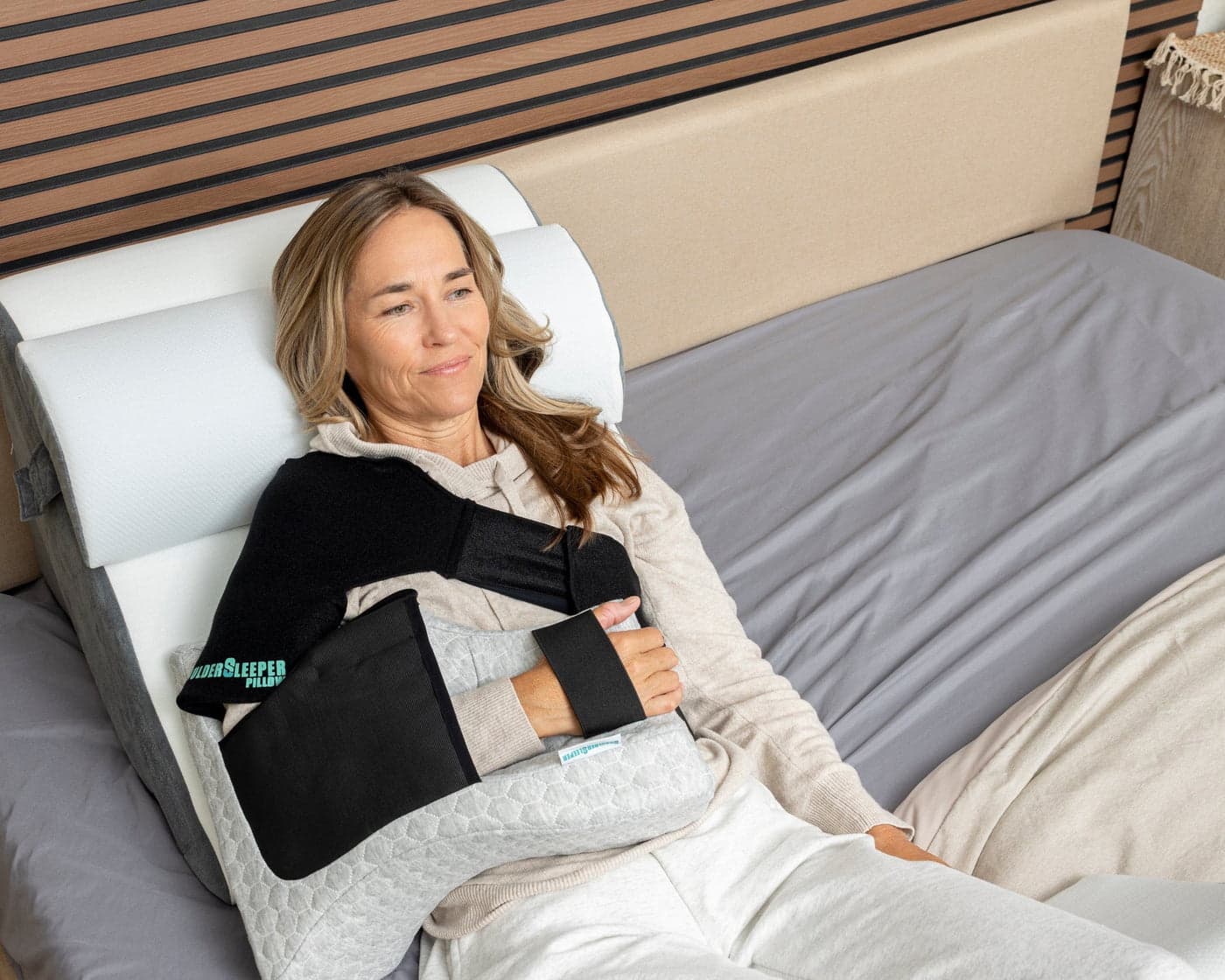
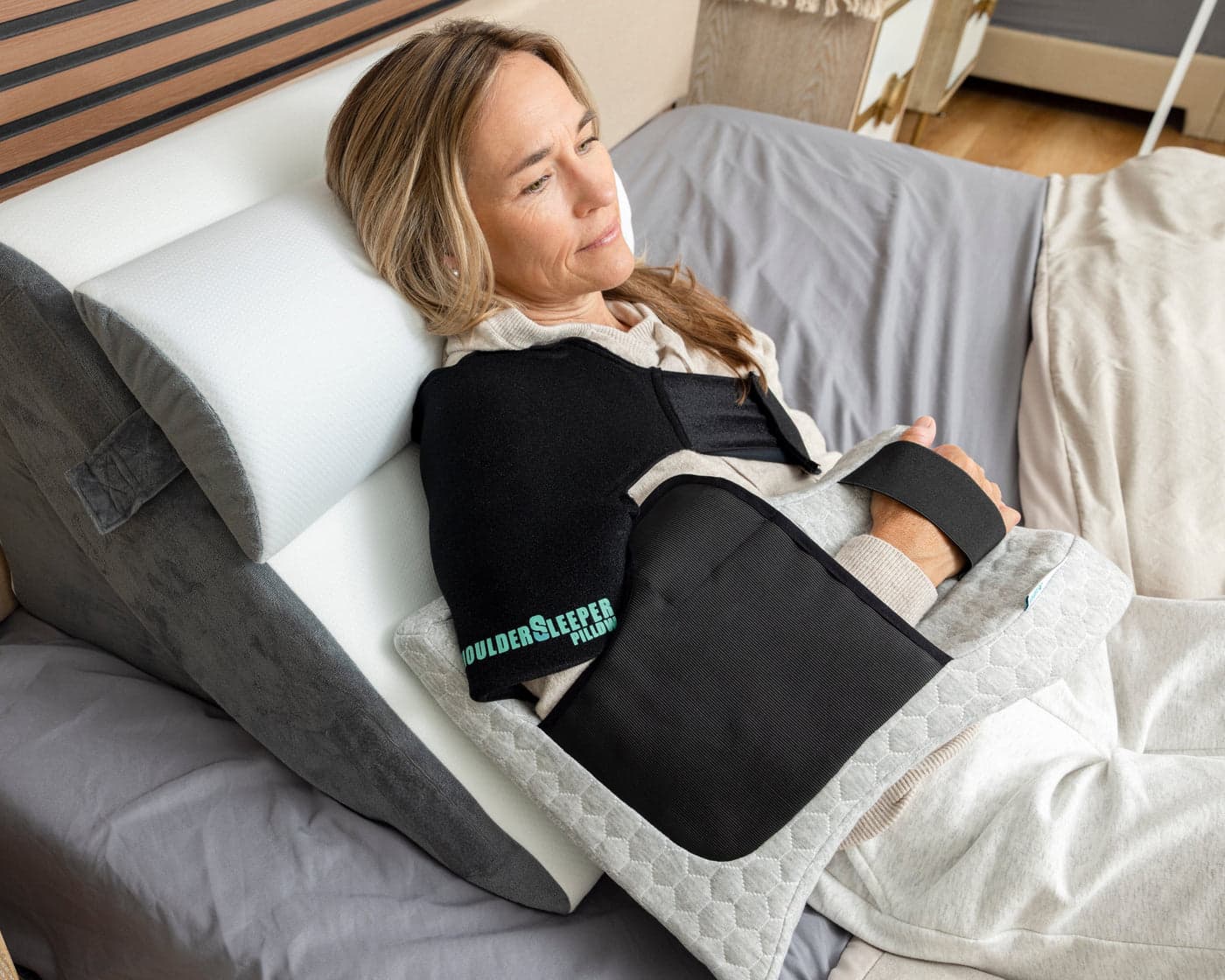
- Sleep propped up. Semi-upright takes tension off the shoulder and makes the sling far less awkward than lying flat.
- Support the elbow separately even with the sling on, so the strap isn't carrying the load all night.
- Deal with the heat. Slings trap warmth against your body. A cooler room, breathable nightwear and a cotton layer under the sling help more than people expect.
- Watch the skin. Check under the strap and around the elbow for redness or rubbing — a small sore becomes a big problem over six weeks.
- Ice before bed if your team has advised it, then get into position promptly.
- Loosen — don't remove — for comfort only if your surgeon has said that's acceptable.
Can I take the sling off in bed?
For some patients, at some stages, with some procedures — yes. For others it's a firm no. UK trusts genuinely contradict each other here, sometimes for the same operation: the Royal Orthopaedic Hospital says a reverse replacement sling "must be worn continuously day and night", while West Suffolk tells reverse replacement patients they "may remove your sling when sitting down or when in bed".
The most useful framing we found comes from Oxford, which makes it conditional on how you sleep rather than issuing a blanket rule: wear the sling at night "particularly if you tend to lie on your side", or — "if you are not a restless sleeper, you could use pillows in front of you to rest your arm on". That's the question to put to your own team.
What to ask your surgeon, specifically: 'Do I need the sling on while I'm asleep? If not, what should be supporting my arm instead?' That second half is the part that gets missed — patients hear 'you can take it off' and interpret it as 'sleep however you like', which is how people wake up having rolled onto a fresh repair.
Frequently asked questions
Do I have to sleep in my sling?
In the early phase, most patients are told yes — because you have no control over your arm once you're asleep, and reflex movements are what put a repair at risk. Some surgeons relax this sooner, particularly where the arm is supported another way. It's a question for your surgical team, and the answer depends on what was done.
How long do you wear a sling after shoulder surgery?
Broadly: hours after a capsular release, days after a subacromial decompression, one to two weeks after a hemiarthroplasty, two to six weeks after a stabilisation, and three to six weeks after a rotator cuff repair or shoulder replacement. NICE has noted that practice varies widely and that there's no evidence establishing the right timing — which is why your surgeon's number is the one that counts.
Why does my neck hurt more than my shoulder?
Almost always the sling strap. It carries the weight of your whole arm across the back of your neck, and after a few days that produces real muscular pain. Padding the strap, supporting the elbow from underneath, and having the sling properly adjusted usually fixes it.
Can I use a pillow instead of the sling at night?
Only if your surgeon says so. Some teams are happy for a support pillow to take over at night once the arm is reliably protected; others want the sling on throughout the early phase. Ask the question directly — and ask what should support the arm if the sling comes off.
What happens if I take the sling off too early?
The main risk is a re-tear or a stretched repair — the tissue is still attaching itself even when the pain has settled, and it feels stronger than it is. If you've had an accidental big movement, don't panic, but do mention it at your next appointment, especially if pain or weakness changed afterwards.
Sources
- 1.NG157: Joint replacement (primary): hip, knee and shoulder — rationale and impact — National Institute for Health and Care Excellence (NICE)
- 2.Rotator cuff repair — patient information — Oxford University Hospitals NHS Foundation Trust
- 3.Reverse total shoulder replacement — patient information — Oxford University Hospitals NHS Foundation Trust
- 4.Rotator cuff repair — after surgery care — University Hospital Southampton NHS Foundation Trust
- 5.Subacromial decompression — patient guidance — Royal Orthopaedic Hospital NHS Foundation Trust
- 6.Reverse total shoulder replacement: recovery and physiotherapy advice — West Suffolk NHS Foundation Trust
- 7.Rotator cuff injuries — clinical practice guideline — American Academy of Orthopaedic Surgeons
- 8.Wearing a sling following shoulder surgery — Sandwell and West Birmingham NHS Trust