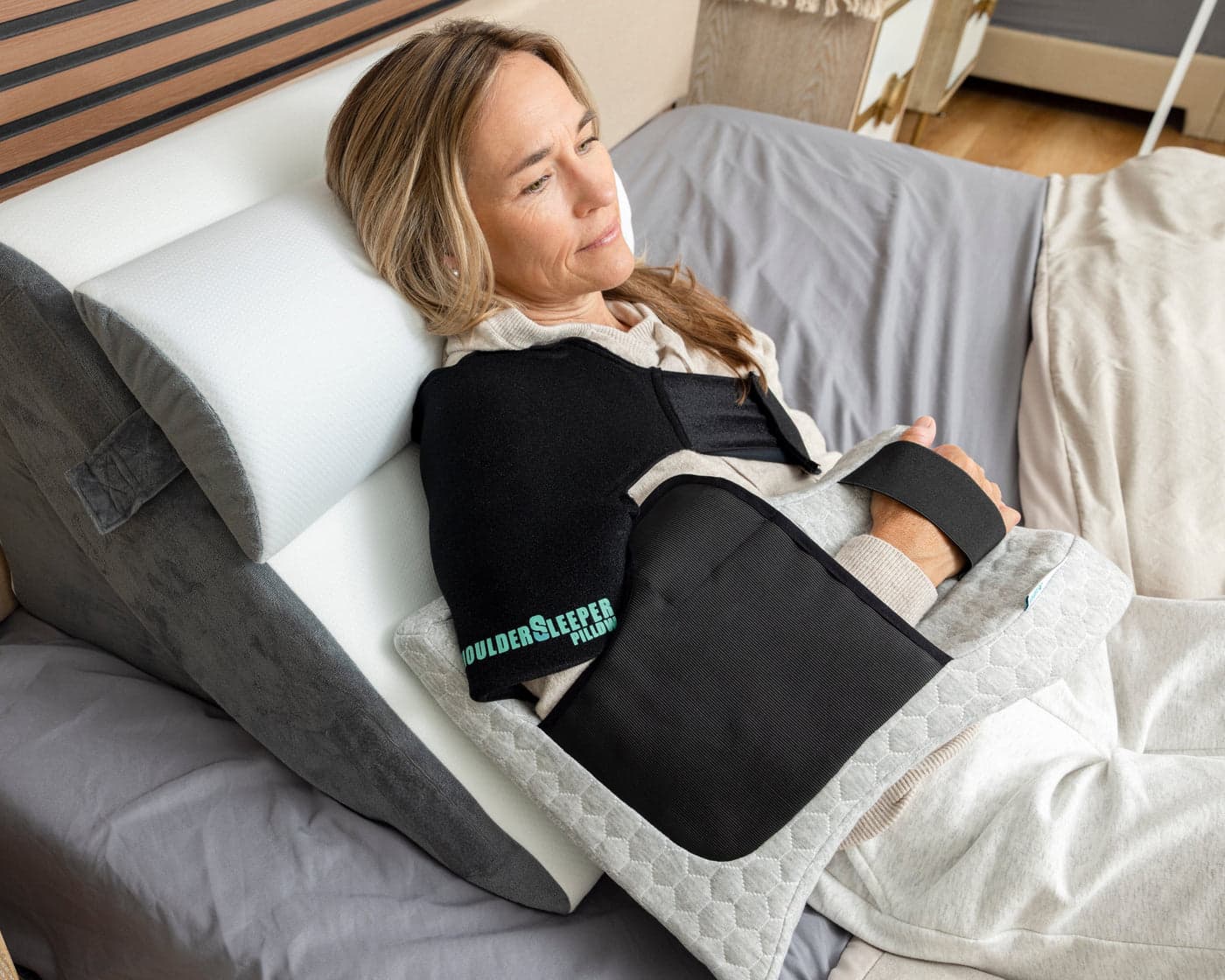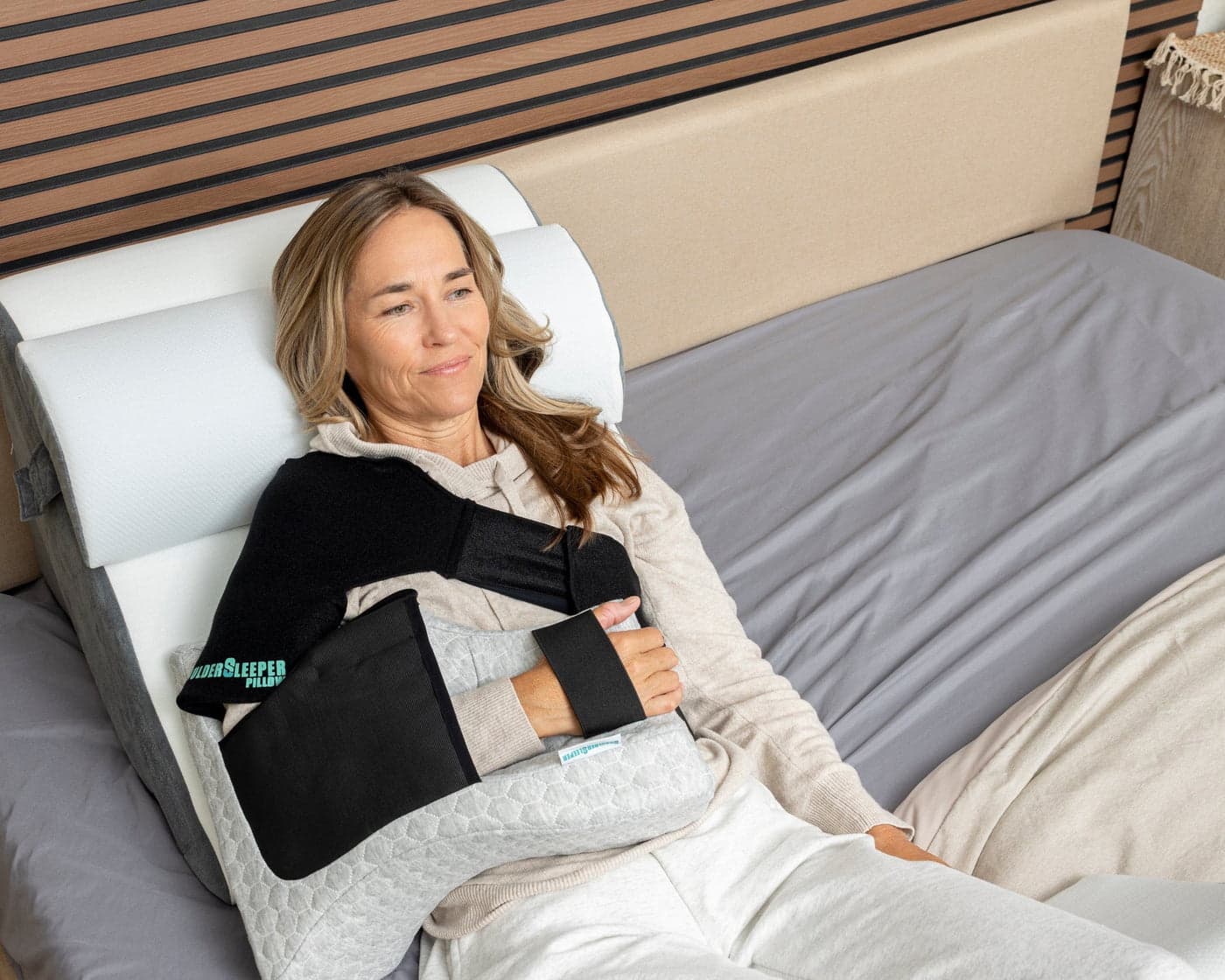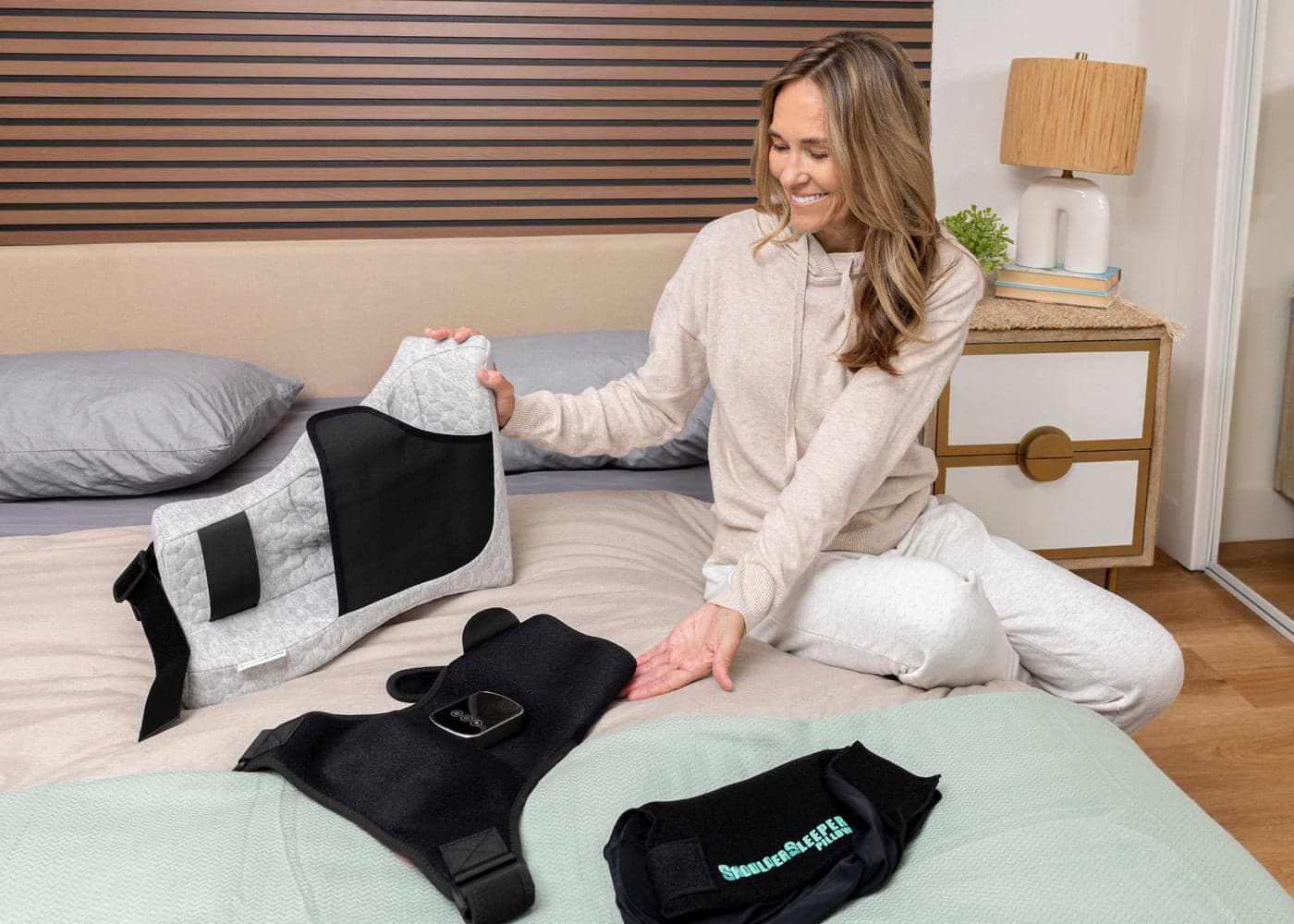
How to Sleep After Shoulder Surgery: Positions, Setup and Week by Week
Sleep is the hardest part of shoulder recovery and the part nobody prepares you for. Here's the position NHS trusts actually recommend, how to set your bed up, and what the research says about when sleep really comes back.
Updated 11 August 2026 · 14 min read
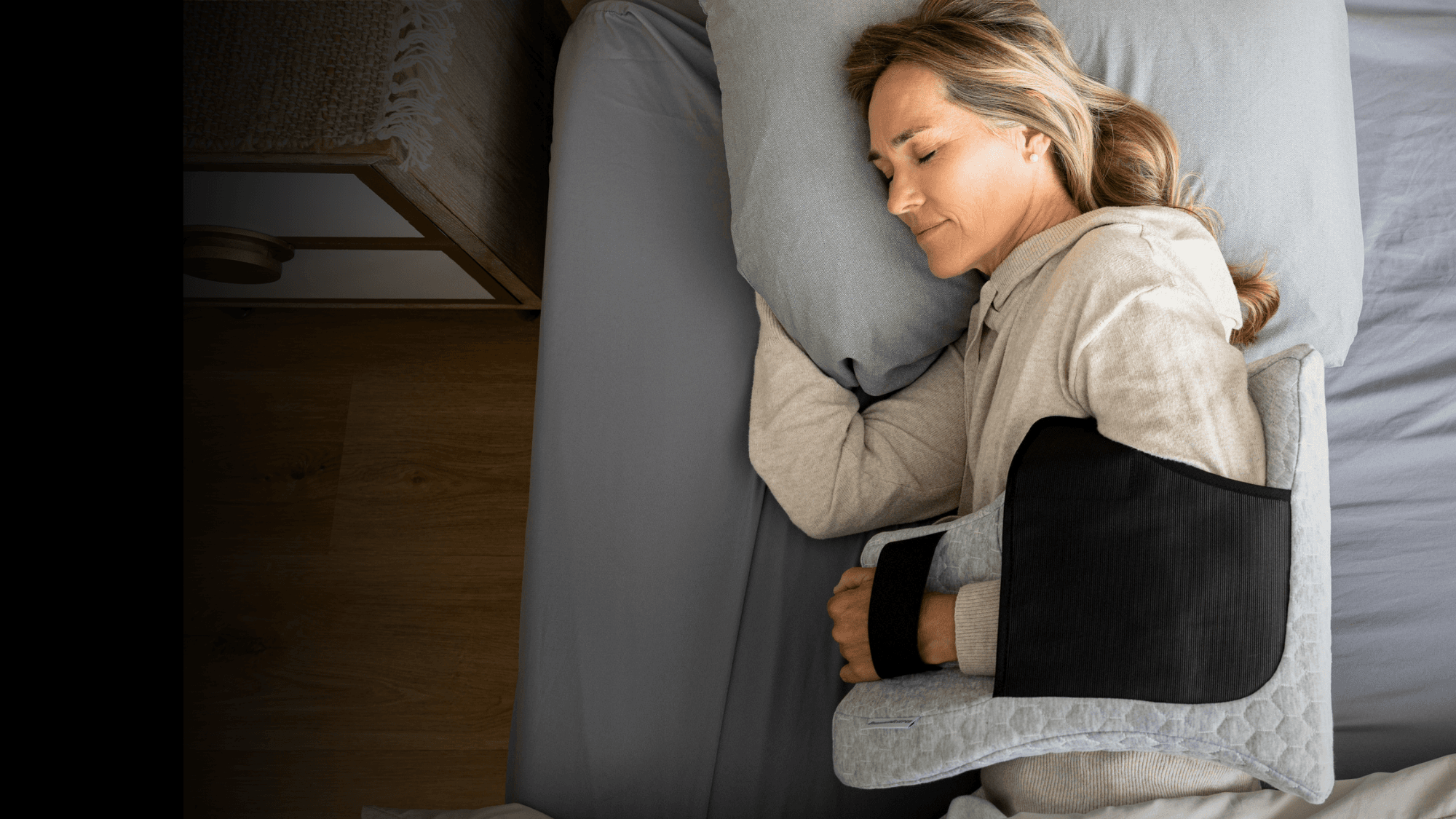
Ask anyone who's had a rotator cuff repaired what the worst part was and they rarely say the operation. They say the nights. You come home, the nerve block wears off somewhere around 2am, and you discover that the position you've slept in your whole adult life is now unavailable.
You're in very normal company: in one study of 326 patients undergoing rotator cuff repair, 89% reported sleep disturbance before surgery. The good news is that this is substantially a setup problem, and setup is something you can fix.
The positions NHS trusts actually recommend
Strip away the internet advice and UK patient leaflets are remarkably consistent. Sandwell and West Birmingham put it plainly: "We recommend you lie on your back or the opposite side to your operated arm and use ordinary pillows for comfort and support."
On your back
The most common starting point, and the position most patients migrate to. Research tracking actual sleeping positions after cuff repair found back sleeping rose from 39% before surgery to 85% at two weeks afterwards, with positions resembling baseline again by around 24 weeks.
The detail that matters most: support under the elbow. Oxford University Hospitals advise that "if you are lying on your back to sleep, you may find placing a small towel or pillow under your elbow and upper arm is comfortable". Without it, the weight of the forearm hangs off the healing shoulder all night.
On your non-operated side
Contrary to a lot of online advice, this is generally allowed from the start — no UK trust leaflet we reviewed delays it. The requirement is that the operated arm has somewhere to rest. Gateshead's guidance: "If you are lying on your non-operated side, you can fold or hug a pillow in front of you to support the arm."
On the operated shoulder — about six weeks
This is the clearest rule in UK guidance. Oxford's rotator cuff leaflet: "For 6 weeks: Do not lie on the side on which you had your operation. After this time, be guided by pain." Gateshead and South Tees say the same. Some replacement protocols differ — Cambridge advises back sleeping for two weeks after a total shoulder replacement — so your own leaflet wins.
Do you have to sleep sitting up?
Less than you've been told. UK trusts mention it as an option rather than an instruction — South Tees says "initially you may find it more comfortable to sleep in a more upright position supported by pillows", and Cambridge that "you may need to sleep higher, using extra pillows". Notably, none of them specify a number of weeks.
The vivid "sleep in a reclining armchair" advice that circulates widely actually comes from leaflets about fractures, not about surgery. And at least one shoulder surgeon has argued publicly that the recliner tradition lacks an evidence base, suggesting instead a modest 20–30° incline built from pillows — a "lazy beach chair" position.
The practical takeaway: if propping up makes you comfortable, do it, and lower the angle as you heal. If you're comfortable flatter and your team hasn't told you otherwise, you're not doing it wrong.
How to set your bed up
The most detailed pillow protocol we found in NHS guidance comes from Sandwell and West Birmingham, and it's worth following closely:
- On your side: "one pillow slightly folded under your neck… Fold a pillow in half and place it under your operated arm for support, and tuck a pillow along your back to help prevent you rolling onto the operated shoulder during the night."
- On your back: "Place a folded pillow under the elbow of the operated arm to support it."
Three principles sit behind that: support the whole arm rather than just the shoulder, block the roll before it reaches the joint, and keep your neck neutral so you're not trading a shoulder problem for a neck one. Add a pillow under your knees if you're propped up, or you'll slide down the incline overnight.
Week by week: what the research shows
One finding is worth knowing in advance, because it saves a lot of despair: measured sleep quality after cuff repair shows no significant improvement during the first month. It then improves steadily — average sleep-quality scores fell from 7.19 before surgery to 4.67 at three months and 3.81 at six months on the Pittsburgh Sleep Quality Index, where lower is better.
- Nights 1–3
The nerve block wears off
Often the hardest nights. Stay ahead of the pain with regular medication rather than waiting for it to build. Most people find some degree of propping up helps at this stage, and getting in and out of bed is easier from an incline.
- Weeks 1–4
Don't expect the numbers to move yet
This is the phase where sleep quality measurably doesn't improve much — the repair is still acutely sore and you're locked out of your usual positions. Back sleeping becomes the norm for most patients within a fortnight. Getting the setup right matters more here than at any other point.
- Weeks 4–6
The sling comes off, and positions open up
Most cuff repair protocols run the sling to around six weeks, and night wear often outlasts daytime use. As it comes off, remember the new hazard: the arm drifting across your body while you're asleep on your other side.
- 6 weeks–3 months
Real improvement
Past six weeks you can usually start testing the operated side, guided by pain. Sleep quality improves markedly through this window — the odds of being free of sleep disturbance are several times higher at three months than at baseline. Flare-ups after harder physiotherapy sessions are normal.
- 6 months–2 years
Most, but not all, of the way back
Around 77% of patients have their sleep disturbance resolved by six months, rising to roughly 81% at two years. Honest counterweight: pooled data suggests 37–41% still report some ongoing disturbance, so if you're not perfectly back to normal, you're not unusual.
Why the pain is worse at night
It's genuinely multifactorial, and the honest answer is that there's no scientific consensus. A 2024 review of the mechanisms lists changes in skin temperature, subacromial pressure, synovitis and blood flow velocity as contributors.
Two popular explanations are worth correcting, because you'll read both:
- "Lying flat squeezes the shoulder." Measured subacromial pressures are actually lowest lying on your back — it's side-lying and lying on your front that generate the highest pressures. Which is precisely why the operated side is off-limits.
- "Blood flow to the tendon drops at night." The research points the other way: night pain has been associated with increased flow in the anterior humeral circumflex artery, interpreted as a sign of synovitis rather than a lack of circulation.
What's not in dispute is the practical bit: with nothing to distract you, and an arm that's unsupported unless you make it otherwise, night is when a healing shoulder makes itself known.
Practical things that help
- Ice, following your own trust's dose. Guidance varies more than you'd expect: Oxford advises 10–15 minutes several times a day with a damp tea towel between the pack and your skin, while the Royal Orthopaedic Hospital suggests 20–30 minutes every 2–3 hours. Ice is not advised if you have diabetes, Raynaud's or an infection.
- Take pain relief on schedule rather than waiting for pain to build — and ask your pharmacist how to time doses around bedtime for the medicines you've actually been given.
- Build the setup at nine, not at midnight. Constructing a sleep position while exhausted goes badly.
- Sit-to-lie, don't lie-to-sit. Sit on the edge of the bed, lower yourself sideways onto your good arm, then swing your legs up. Reverse it to get out, and never push up with the operated arm.
- Keep the room cool. Slings and support pillows trap heat, and overheating wakes people as often as pain does by the two-week mark.
- Put everything on your good-arm side — water, phone, painkillers, light switch.
Should you sleep in the sling?
UK trusts genuinely disagree on this — Southampton says "always wear the sling at night for the first five to six weeks", while West Suffolk tells reverse replacement patients they "may remove your sling when sitting down or when in bed". Oxford offers the most useful nuance, making it conditional on how you sleep: wear it at night "particularly if you tend to lie on your side", or if you're not a restless sleeper, rest the arm on pillows in front of you instead.
Which means it's a question for your surgeon, not a matter of preference. We go through the reasoning, durations by procedure and how to make sling nights bearable in our guide to sleeping in a sling.
Frequently asked questions
What is the best sleeping position after shoulder surgery?
UK trusts consistently recommend lying on your back or on your non-operated side, with the operated arm supported by a folded pillow — under the elbow if you're on your back, hugged in front of you if you're on your side. Avoid the operated side for around six weeks, then be guided by comfort and your surgeon's advice.
How long do I have to sleep sitting up after shoulder surgery?
There's no fixed period, and it's more optional than most people assume. NHS leaflets mention propping up as something you may find more comfortable initially, without specifying a duration. Lower the angle as comfort allows; if you're comfortable flatter and your team hasn't said otherwise, that's fine.
When can I sleep on my side after shoulder surgery?
You can generally sleep on your non-operated side straight away, provided the operated arm is supported on a pillow in front of you. For the operated side, most UK guidance says avoid it for about six weeks and then be guided by pain — some procedures, particularly replacements, have different rules.
How long before I sleep normally again?
Research suggests sleep quality doesn't improve much in the first month, then improves steadily: around 77% of rotator cuff repair patients have their sleep disturbance resolved by six months and roughly 81% by two years. A significant minority still report some disturbance beyond that, so slower progress isn't necessarily a problem — but tell your team if sleep is getting worse rather than better.
What if I roll onto my shoulder in my sleep?
It's the most common worry, and the practical fix is physical rather than mental: NHS guidance specifically recommends tucking a pillow along your back to stop you rolling onto the operated shoulder. If it happens and the pain settles as usual, mention it at your next appointment rather than panicking.
Can I sleep in a recliner instead?
You can, and many people do for the first weeks. Worth knowing that the recliner tradition has a thinner evidence base than its popularity suggests — what matters is a stable incline and a supported arm, which you can also achieve in your own bed. We compare the options in our recliner-versus-bed guide.
Sources
- 1.Wearing a sling following shoulder surgery (pillow positioning guidance) — Sandwell and West Birmingham NHS Trust
- 2.Rotator cuff repair — patient information — Oxford University Hospitals NHS Foundation Trust
- 3.Reverse total shoulder replacement — patient information — Oxford University Hospitals NHS Foundation Trust
- 4.Rotator cuff repair — recovery advice — Gateshead Health NHS Foundation Trust
- 5.Rotator cuff repair — South Tees Hospitals NHS Foundation Trust
- 6.Advice following total shoulder replacement — Cambridge University Hospitals NHS Foundation Trust
- 7.Rotator cuff repair — after surgery care (sling at night) — University Hospital Southampton NHS Foundation Trust
- 8.Prevalence and resolution of sleep disturbance after rotator cuff repair (Dolan et al.) — Journal of Shoulder and Elbow Surgery, 2022 — PubMed
- 9.Sleep quality trajectory following arthroscopic rotator cuff repair (PSQI data) — International Journal of Environmental Research and Public Health, 2021
- 10.Systematic review: sleep disturbance before and after rotator cuff repair — PubMed Central
- 11.Mechanisms of night pain in rotator cuff disease — review — Clinics in Shoulder and Elbow, 2024
- 12.Subacromial pressures in varying sleep positions (Werner et al.) — PubMed
- 13.Increased blood flow in the anterior humeral circumflex artery and night pain (Terabayashi et al.) — PubMed
- 14.Shoulder mobilisation and ice guidance — Royal Orthopaedic Hospital NHS Foundation Trust