Shoulder Replacement Recovery: What to Expect (Anatomic and Reverse)
How long you'll be in hospital, what the sling and rehab actually involve, and what the National Joint Registry says about how long a shoulder replacement really lasts — including the age effect nobody mentions.
Updated 30 July 2026 · 14 min read
Shoulder replacement has quietly become one of the more successful operations in orthopaedics — and one of the least understood by the people having it. Most patients arrive knowing roughly what a hip replacement involves and almost nothing about what a shoulder one means for their next six months.
The two operations, and why yours was chosen
There are two main types, and the difference matters for everything that follows.
| Anatomic (conventional) replacement | Reverse replacement | |
|---|---|---|
| Who it's for | Osteoarthritis with an intact rotator cuff and adequate glenoid bone | Cuff tear arthropathy, or arthritis without a working rotator cuff; also some fractures |
| How it works | Preserves the normal ball-and-socket. Relies on your rotator cuff | Ball and socket are swapped over, so the deltoid powers the arm instead of the cuff |
| Main goal | Pain relief and restored movement | Primarily pain relief; movement gain is a secondary benefit |
| Typical age (England) | Median 69 | Median 76 |
| How common | 21,180 elective cases | 39,408 — now the commonest type |
NICE's position is straightforward: for osteoarthritis with no rotator cuff tear, if the glenoid bone is adequate, offer a conventional total shoulder replacement. Reverse replacement exists for the shoulders where the cuff can't do its job.
Hospital stay
Shorter than most people expect. The Royal National Orthopaedic Hospital aims to discharge within one to two days; Royal Berkshire says most people go home on the second post-operative day; Leeds notes many patients are now suitable for day surgery. Registry analysis puts the mean stay at 1.3–2.8 days.
Day-case reverse replacement was just 1.2% of cases across 2012–2022 — but had reached 27.5% by 2021, and the outcomes look reassuring: lower readmission for complications (1.6% versus 6.3%) and comparable satisfaction.
The recovery timeline
Oxford's current guidance describes four phases, and the shape is similar for both operations — though the restrictions differ.
- In hospital
Phase 1 — getting moving
NICE recommends rehabilitation from a physiotherapist or occupational therapist on the day of surgery where possible, and within 24 hours at the latest. You'll be shown how to manage the sling, dress one-handed, and start hand and elbow movement.
- Discharge to 6 weeks
Phase 2 — sling, and waist-level tasks
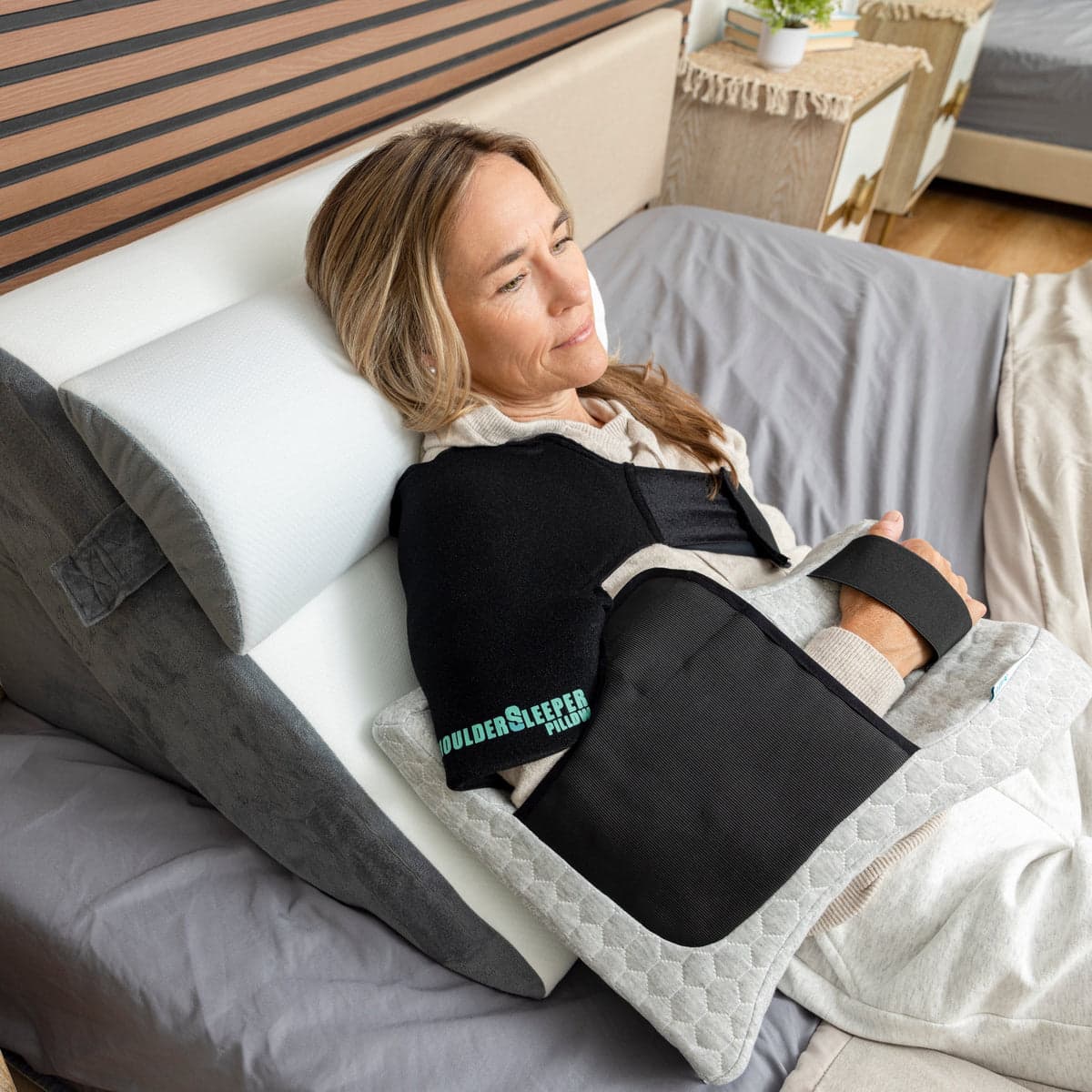
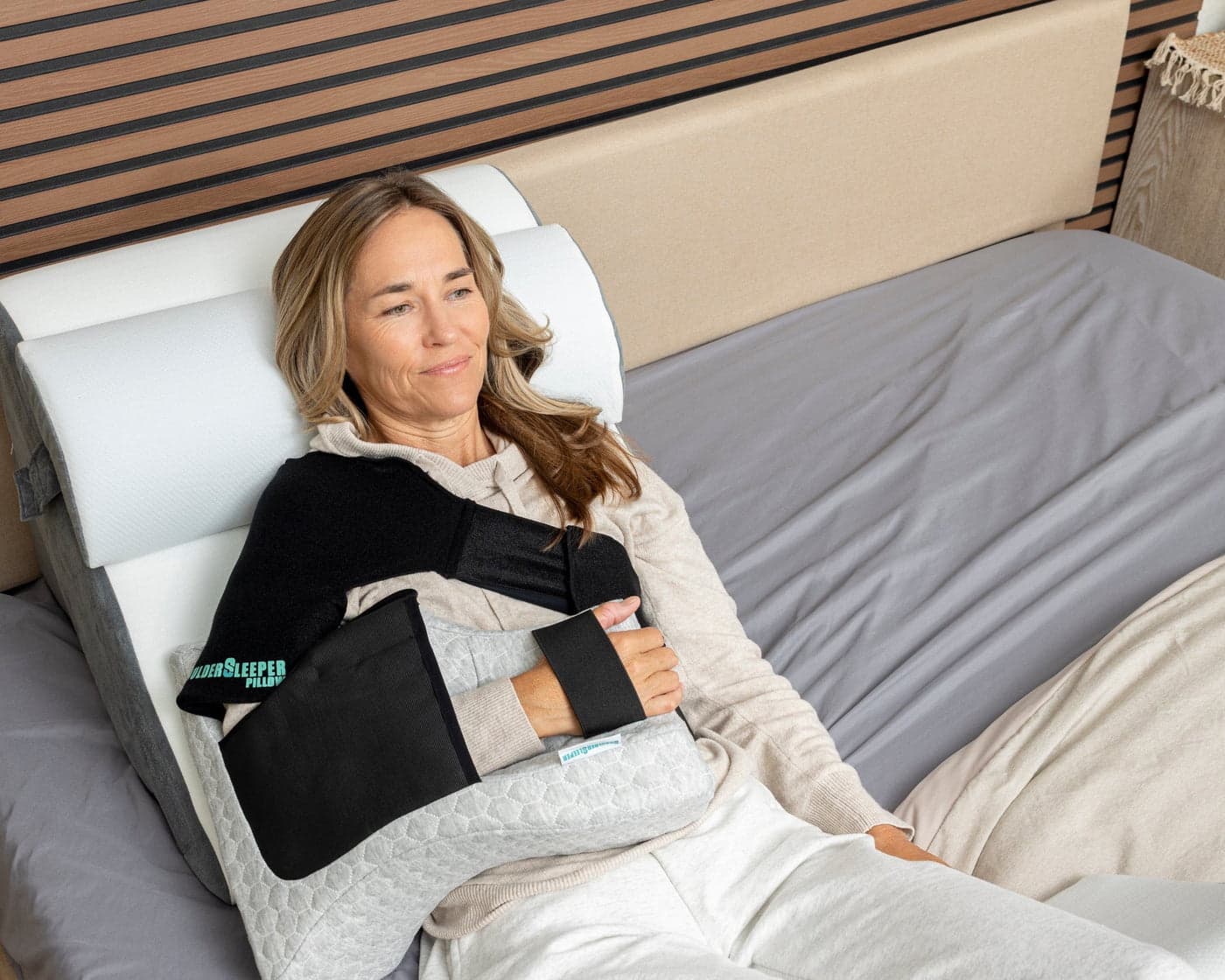
Oxford's current advice for anatomic replacement is to use the sling gradually less over the first four weeks, for comfort. For reverse replacements it's four weeks with a body belt for the first two. Both: avoid taking the arm out to the side and twisting backwards, and don't lean your body weight through the operated arm. Some trusts run a stricter six-week protocol — follow yours.
- 6–12 weeks
Phase 3 — lifting the arm away from the body
More active movement and more of daily life comes back. Wound review and suture removal happen much earlier, at around 10–14 days, and your follow-up clinic is usually three to six weeks after discharge.
- 12 weeks onwards
Phase 4 — stretching and strengthening
More vigorous stretching and a return to activities. Most improvement lands within the first six months, but strength and movement keep improving for up to two years.
How long does a shoulder replacement last?
This is the question everyone asks, and the UK happens to have world-class data on it. The National Joint Registry's 2025 report covers 86,882 primary shoulder replacements carried out between 2012 and 2024.
| Implant type | At 5 years | At 10 years | At 12 years |
|---|---|---|---|
| Reverse total replacement | 3.02% | 4.21% | 5.07% |
| Anatomic total replacement | 3.70% | 6.35% | 8.59% |
| Hemiarthroplasty (partial) | 7.81% | 10.99% | 11.74% |
| All elective cases | 4.21% | 6.49% | 7.82% |
In plain terms: roughly 94–96% of modern shoulder replacements are still in place at ten years. Trust leaflets tend to quote around 90% "functioning well", which is a different and slightly lower bar — a working implant isn't the same as a delighted patient.
The age effect — the number that actually matters to you
An overall figure hides an enormous difference. From the same registry data, ten-year revision rates by group:
| Group | Revision within 10 years |
|---|---|
| Men under 55 | 16.95% |
| Women under 55 | 13.92% |
| Women 55–64 | 10.29% |
| Women 65–74 | 5.88% |
| Women 75+ | 2.80% |
A shoulder replacement in someone under 55 is roughly five to six times more likely to need revision by ten years than one in someone over 75. That's not a reason to avoid surgery — it's a reason to have a specific conversation with your surgeon about your own age and expected demand, rather than taking a headline percentage at face value.
Why each type fails
- Anatomic replacements most often fail because the rotator cuff eventually gives way — the risk accumulates steadily over time, which is why their curve keeps climbing.
- Reverse replacements fail earlier if they fail at all, usually from instability, dislocation or infection, then the risk flattens out.
- One important caveat researchers raise: reverse replacement's lower revision rate partly reflects a higher threshold to revise — a poorly functioning reverse replacement is less likely to be re-operated on. Low revision rates don't automatically mean better function.
How much better will it feel?
Registry patient-reported data shows Oxford Shoulder Scores improving from an average of 16.5 before surgery to 36.2 at six months — a gain of nearly 20 points on a 48-point scale. The registry itself cautions that this sample is relatively small and may not be fully representative, but the direction is unambiguous.
Sleep is worth calling out: research comparing procedures found shoulder replacement patients recover their sleep faster than rotator cuff repair patients — at six months, 31.7% of reverse replacement and 43.8% of anatomic replacement patients were still poor sleepers, versus 63.3% after cuff repair.
Getting back to life
| Activity | Anatomic | Reverse |
|---|---|---|
| Light tasks (kettle with a little water, dusting, cooking) | As soon as you feel able | As soon as you feel able |
| Return to work (desk-based) | 6–8 weeks | 6–8 weeks |
| Driving | 6–8 weeks | 6–8 weeks (8–12 for a manual) |
| Gentle swimming | 6 weeks (freestyle 12) | 12 weeks |
| Light gardening | 6–8 weeks | 8–12 weeks |
| Bowls | 3–6 months | 3–6 months |
| Golf, tennis, badminton, squash | 4–6 months | 4–6 months |
| Manual or overhead work | 3–6 months | 3–6 months |
Long-term restrictions
UK sources are notably vague about permanent limits, and we'd rather say so than invent a number. The one specific UK figure we found — from a North Bristol protocol dated 2015 — advises avoiding lifting more than 2–4 kg above shoulder height long term after a reverse replacement, and notes that reaching behind the back may never fully return and shouldn't be forced. Otherwise, the standard NHS framing is qualitative: be mindful of overhead and heavy tasks, and avoid heavy gardening such as digging for around six months.
Frequently asked questions
How long will I be in hospital after a shoulder replacement?
Usually one to two nights, sometimes three, and increasingly it can be a day case — day-case reverse replacement had reached 27.5% of cases by 2021 with reassuring outcomes. Your team will decide based on your health and your home set-up.
How long does a shoulder replacement last?
National Joint Registry data shows about 4.2% of reverse and 6.4% of anatomic replacements are revised within ten years — so roughly 94–96% are still in place at that point. Your own age matters far more than the average: revision within ten years runs at around 17% for men under 55 and under 3% for women over 75.
What's the difference between an anatomic and a reverse replacement?
An anatomic replacement keeps the normal ball-and-socket arrangement and relies on your rotator cuff, so it needs that cuff to be intact. A reverse replacement swaps the ball and socket over so the deltoid muscle powers the arm instead — which is why it's used when the cuff is torn or not working. Reverse is now the commoner operation in England.
How long will I wear the sling?
Oxford's current guidance is to reduce sling use gradually over about four weeks, for comfort. Reverse replacement patients typically have a sling for four weeks with a body belt for the first two. Some trusts use a stricter six-week protocol, split between full-time and nights only — follow your own.
When can I sleep normally again?
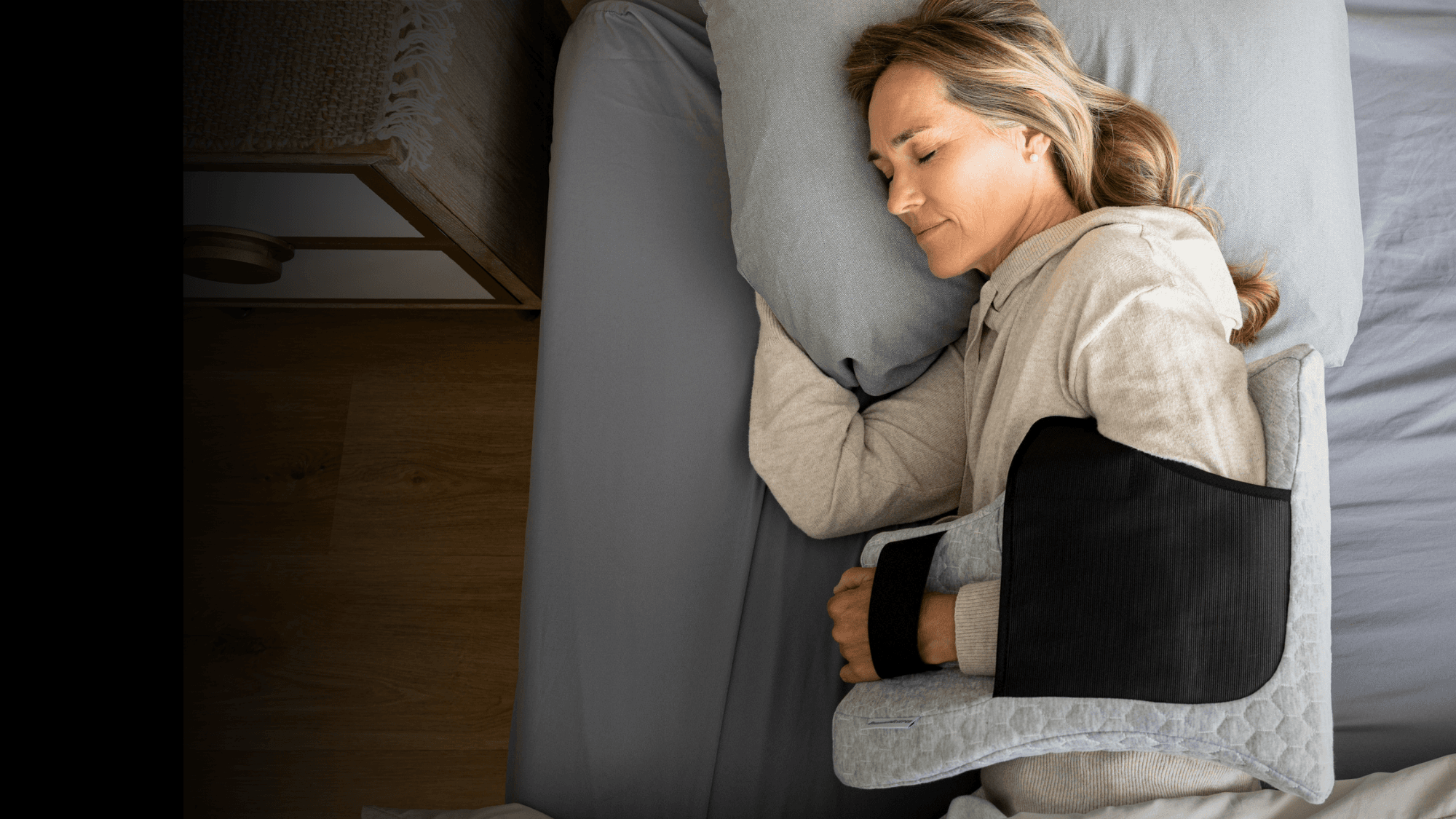
Sleep recovers faster after a replacement than after a cuff repair, but it takes months: at six months, around a third of reverse and just under half of anatomic replacement patients were still classified as poor sleepers. Positioning helps considerably in the meantime — and remember that some arm positions carry a dislocation risk after a reverse replacement, so follow your specific instructions.
Will I be able to lift things overhead afterwards?
Usually yes, within limits, though heavy or repetitive overhead work may be permanently restricted — particularly after a reverse replacement. The one specific UK figure we found suggests keeping overhead loads to around 2–4 kg long term. Ask your surgeon for your own limit rather than assuming.
Sources
- 1.22nd Annual Report 2025 — Shoulder replacement data — National Joint Registry
- 2.NG157: Joint replacement (primary): hip, knee and shoulder — recommendations — National Institute for Health and Care Excellence (NICE)
- 3.Shoulder replacement — patient information (February 2026) — Oxford University Hospitals NHS Foundation Trust
- 4.Reverse total shoulder replacement — patient information (September 2024) — Oxford University Hospitals NHS Foundation Trust
- 5.Total shoulder replacement — patient guide — Royal National Orthopaedic Hospital NHS Trust
- 6.Shoulder replacement surgery (April 2025) — Royal Berkshire NHS Foundation Trust
- 7.Shoulder replacement — patient resource — Leeds Teaching Hospitals NHS Trust
- 8.Day-case shoulder arthroplasty: registry and HES analysis — Annals of the Royal College of Surgeons of England, 2025
- 9.Reverse versus anatomic shoulder replacement: NJR-HES cohort study — BMJ, 2024
- 10.Sleep quality after rotator cuff repair and shoulder arthroplasty — JSES International, 2025
- 11.Shoulder service post-operative rehabilitation guidelines (2015) — North Bristol NHS Trust